
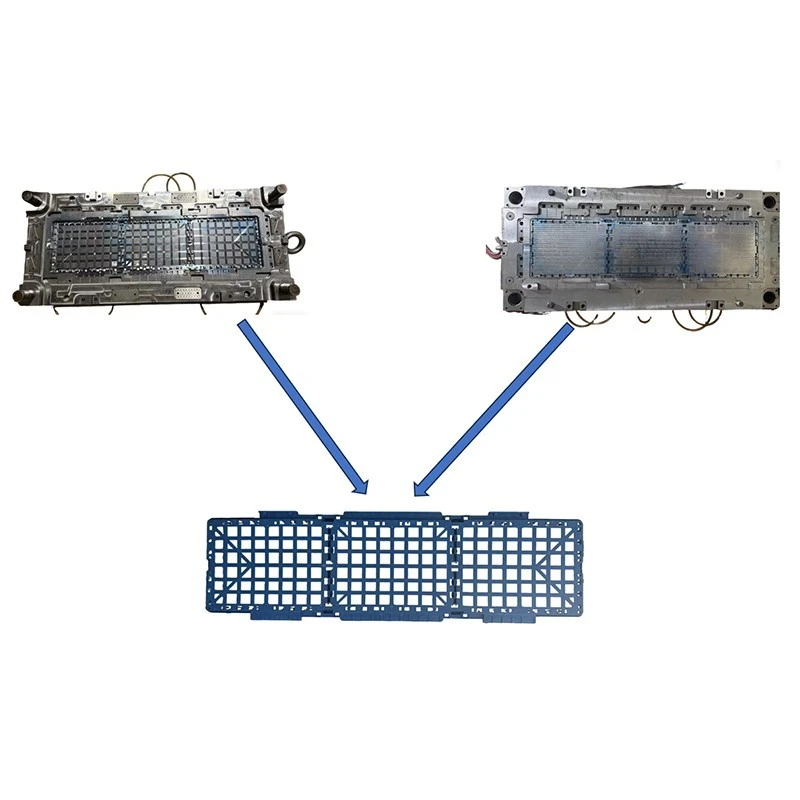
Ningbo Weishuo Molding and Plastic Products Co., Ltd. provides Logistics Turnover Box and Pallet Molds for manufacturing reusable plastic containers used in warehousing, material handling, distribution, and industrial supply chains. The molds are developed around the structural requirements of the finished products, including stacking strength, base rigidity, wall thickness, dimensional accuracy, and compatibility with handling equipment.
Logistics turnover boxes and plastic pallets are repeatedly exposed to stacking loads, forklift handling, conveyor movement, and frequent loading and unloading. Their performance depends on the molded product design as well as material selection, processing conditions, and quality control. Weishuo considers these factors during mold development to support consistent product geometry and practical manufacturing requirements.
Plastic turnover boxes and pallets require appropriate structural support to withstand stacking, handling, and transportation loads. Mold design therefore considers the distribution of reinforcing ribs, corner geometry, base structure, wall thickness, and load transfer between supporting sections.
Rib placement and cross-sectional geometry are developed according to the intended product design. Reinforced corners and a properly configured base can help distribute loads and reduce localized stress concentrations. The objective is to balance structural performance, material consumption, and molding feasibility rather than simply increasing wall thickness.
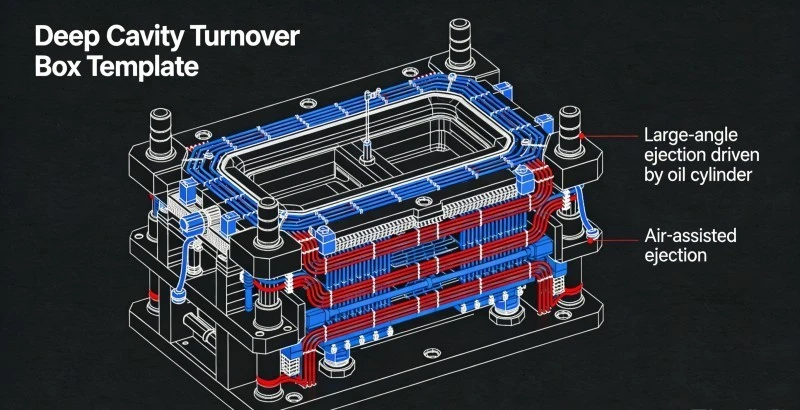
Large logistics containers and pallets often have substantial projected areas, deep cavities, or sections with different wall thicknesses. Uneven cooling can extend cycle times and contribute to warpage or dimensional variation.
Weishuo evaluates cooling channel placement and flow paths according to the mold layout and the thermal characteristics of the molded product. Cooling arrangements are designed to improve heat removal from relevant areas while maintaining practical access for mold manufacturing and maintenance.
Turnover boxes and pallets may need to fit existing racks, conveyors, pallet systems, and automated handling equipment. Dimensional control is particularly important for stacking interfaces, locating features, forklift entry openings, lid interfaces, and interlocking components.
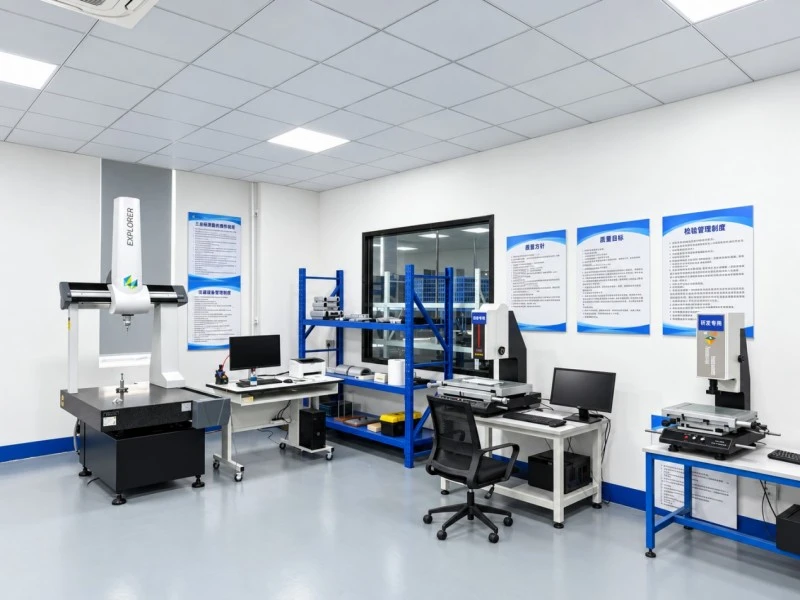
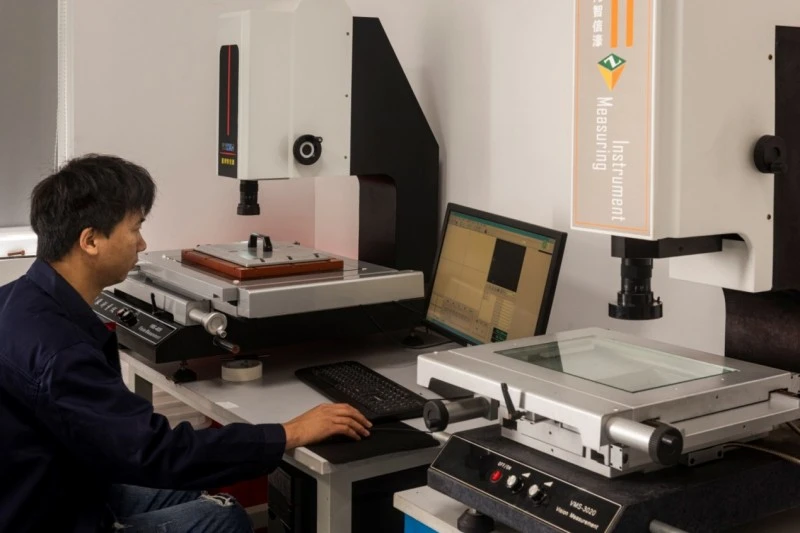
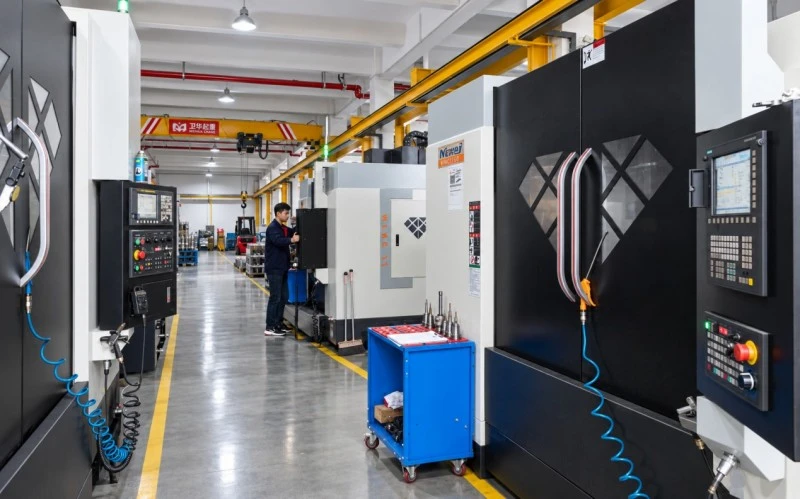
Weishuo Logistics Turnover Box and Pallet Molds develops mold dimensions according to approved drawings, samples, and relevant dimensional standards. CNC machining supports the production of mold cavities, cores, and critical interfaces. Coordinate measuring equipment can be used for dimensional inspection where applicable to the project.
| Product Category | Main Design Requirements | Mold Design Considerations | Intended Application |
| Folding Pallet Box Molds | Folding function, structural stability, and space-efficient storage | Hinge interfaces, locking features, wall thickness distribution, and demolding access | Returnable transport packaging and warehouse storage |
| Stackable Turnover Box Molds | Stable stacking, dimensional consistency, and handling compatibility | Stacking guides, reinforced corners, base structure, and locating features | Distribution centers, manufacturing plants, and inventory handling |
| Plastic Pallet Molds | Load distribution, forklift access, and dimensional stability | Deck structure, reinforcing ribs, support blocks, and forklift entry geometry | Material handling, warehousing, and industrial transportation |
| Anti-Static Container Molds | Compatibility with conductive or static-dissipative plastic compounds | Geometry, material processing requirements, and dimensional control | Electronic component handling and sensitive manufacturing environments |
| Customized Industrial Container Molds | Product-specific dimensions, capacity, and handling conditions | Cavity layout, cooling channels, ejection system, and tooling configuration | Specialized storage, production-line transfer, and returnable packaging |
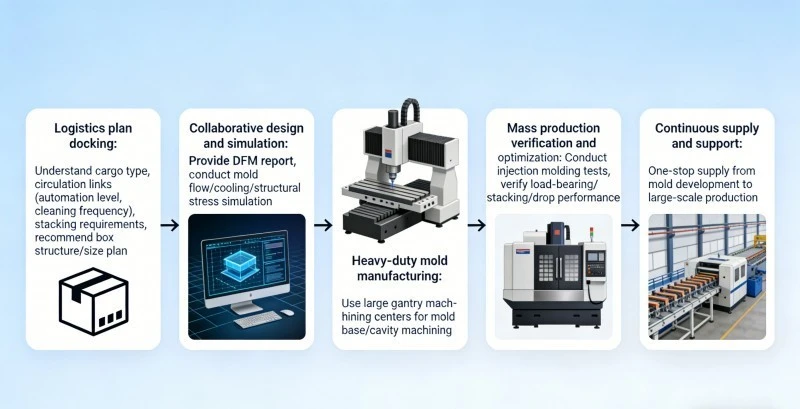
Weishuo reviews the proposed container or pallet design, product dimensions, material requirements, expected production volume, stacking configuration, and handling conditions. Existing drawings, physical samples, and interface dimensions provide the basis for establishing the mold specifications.
The Logistics Turnover Box and Pallet Molds structure is developed according to the product geometry and injection molding requirements. Design review can cover wall thickness, draft angles, rib arrangement, gate location, cooling layout, ejection strategy, and potential manufacturing difficulties.
Mold flow analysis or structural simulation may be considered where appropriate to the project scope. The purpose is to identify potential filling, cooling, warpage, or structural concerns before finalizing the tooling design.
Mold manufacturing involves machining the mold base, cavity, core, and associated components according to the approved design. CNC machining and other suitable manufacturing processes are selected according to the mold's dimensions, geometry, and tolerance requirements.
Critical dimensions and interfaces are inspected according to the project quality plan. Mold assembly also includes checking the alignment, guiding components, ejection mechanism, and other relevant functional elements.
Trial molding is used to assess filling, cooling, ejection, part appearance, and dimensional consistency. Where required, adjustments are made to the mold or processing parameters before production approval.
Product-specific tests may include dimensional inspection, stacking assessment, load testing, or drop testing, depending on the intended application and agreed acceptance criteria. Test methods and results should correspond to the actual product specification.
In addition to mold development, Weishuo can discuss injection molding production for compatible logistics container projects. This arrangement can coordinate tooling development with finished-part manufacturing, subject to machine capacity, product specifications, production schedules, and order requirements.
Maintenance recommendations, spare component requirements, and future mold modifications can also be established according to the tooling configuration and production plan.
HDPE and PP are common materials for injection-molded logistics containers and pallets. The appropriate resin grade depends on impact requirements, stiffness, operating temperature, chemical exposure, and the intended load conditions. Material selection should be confirmed before mold design is finalized.
Yes. Existing product drawings or physical samples can be used as references for mold development. Critical dimensions, stacking features, locating interfaces, and other functional details are reviewed to establish the new tooling requirements. Where necessary and available, 3D scanning or additional dimensional measurement can support reverse engineering.
Cooling efficiency is addressed through the arrangement of cooling channels, the distribution of heat-generating sections, and the product's wall thickness. The cooling layout is designed according to the mold geometry and may be evaluated through simulation or trial molding where appropriate. Actual cycle time depends on the resin, part dimensions, processing conditions, and quality requirements.
Weishuo can discuss integrated mold development and injection molding production for suitable projects. The scope depends on product dimensions, machine capacity, production volume, quality requirements, and delivery arrangements. Tooling ownership, production terms, and long-term supply conditions should be confirmed in the commercial agreement.
Address
Building 6,300# Chuanghui Road,Zhongnan Hi-Tech Binhai Industrial Zoo, Ninghai, Ningbo, Zhejiang, China
Tel