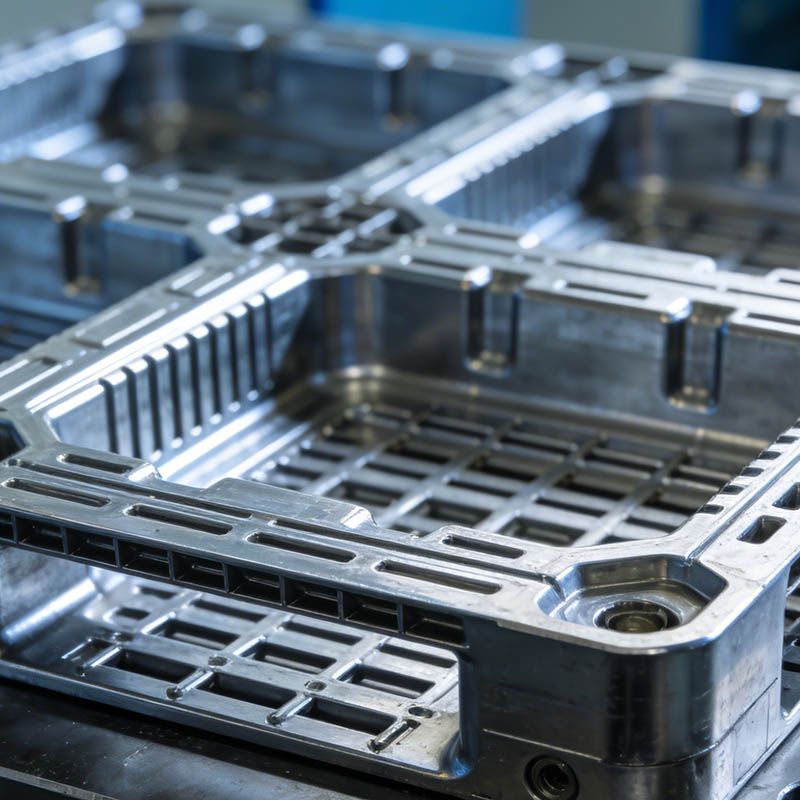

Weishuo provides Logistics turnover boxes and pallet molds engineered for demanding warehousing, transportation, and material-handling applications. By combining structural optimization, efficient cooling, precision machining, and automation-oriented mold design, these solutions help manufacturers produce durable plastic logistics containers with consistent dimensions, high load-bearing capability, and reliable production efficiency.
Reusable plastic turnover boxes and pallets are essential components of modern logistics systems. Their performance depends not only on the selected HDPE or PP material but also on the precision and engineering quality of the injection mold used to manufacture them. A well-designed mold can improve dimensional stability, stacking performance, impact resistance, cooling efficiency, demolding speed, and long-term production consistency. This article explains the main engineering considerations behind industrial logistics container molds, including structural reinforcement, cooling-channel design, automation compatibility, mold durability, product applications, and the development process from concept to mass production.

Table of Contents
Why Are Logistics Turnover Boxes and Pallet Molds Important?
How Does Structural Design Improve Container Performance?
How Do Cooling and Demolding Systems Improve Production?
How Can Precision Molds Support Automated Logistics?
What Makes a Mold Suitable for Long-Term Production?
Which Logistics Container Applications Can Be Supported?
How Should Manufacturers Evaluate Different Mold Solutions?
What Is the Mold Development Process?
Why Are Logistics Turnover Boxes and Pallet Molds Important?
Logistics containers operate in environments where repeated handling, stacking, loading, unloading, and transportation can place substantial stress on plastic components. Unlike single-use packaging, reusable boxes and pallets may complete thousands of handling cycles, making dimensional consistency and structural reliability important factors in overall operating costs.
The injection mold is therefore more than a forming tool. It directly influences wall thickness distribution, reinforcing ribs, corner geometry, stacking interfaces, locating features, and the overall repeatability of manufactured containers. When the mold is properly engineered, manufacturers can achieve consistent parts while reducing problems such as deformation, excessive flash, difficult demolding, and dimensional variation.
For manufacturers developing reusable logistics packaging, working with an experienced industrial container mold supplier can help connect product requirements with practical injection molding considerations.
How Does Structural Design Improve Container Performance?
Large logistics boxes and pallets must balance strength with material efficiency. Simply increasing wall thickness can increase material consumption, cooling time, product weight, and production cost. A more effective approach is to use engineered structural features to distribute mechanical loads throughout the container.
Important design considerations include:
- Reinforcing ribs: Properly positioned ribs can distribute loads and reduce localized stress concentration.
- Base reinforcement: Strengthened bottom structures help containers withstand stacking and repeated material handling.
- Corner geometry: Appropriate radii can reduce sharp stress concentrations and improve molded-part durability.
- Stacking interfaces: Accurate stacking guides help maintain stable alignment between containers.
- Forklift access: Pallet and box structures can be designed around the requirements of mechanical handling equipment.
For high-volume applications, these details can influence not only product performance but also material utilization and manufacturing efficiency. The objective is to achieve an effective balance between structural strength, product weight, mold complexity, and cycle time.
How Do Cooling and Demolding Systems Improve Production?
Large plastic logistics containers often contain relatively thick sections. During injection molding, these areas require effective heat removal before the part can be safely ejected. Poor cooling can increase cycle time and may contribute to warpage or dimensional instability.
Advanced mold engineering can address these challenges through carefully positioned cooling channels that provide more uniform temperature control across thick-wall regions. Efficient cooling allows manufacturers to shorten production cycles while improving consistency between molded parts.
Demolding is another important consideration. Deep cavities and complex container geometries can make ejection difficult. Properly designed ejector systems, inclined ejectors, and other release mechanisms can help remove parts smoothly while reducing the risk of deformation, vacuum adhesion, or surface damage.
For high-volume production, even a small improvement in cycle time can become significant when multiplied across hundreds of thousands of production cycles. This makes cooling and ejection design important factors when selecting a mold manufacturer.
How Can Precision Molds Support Automated Logistics?
Modern warehouses increasingly rely on conveyors, robotic grippers, automated storage systems, and standardized material-handling equipment. Plastic containers must therefore maintain sufficiently consistent dimensions to interact reliably with these systems.
Critical features may include outer dimensions, stacking tabs, locating grooves, pallet interfaces, and automated gripping surfaces. Precision machining and dimensional inspection help ensure that these features remain consistent throughout mass production.
Automation-oriented mold design can also consider the relationship between molding, part removal, and subsequent conveying. When container dimensions are stable, manufacturers have a stronger foundation for integrating automated handling equipment into warehouse and production workflows.
This is particularly relevant for industries that operate large fleets of reusable containers. Consistency across batches can simplify warehouse organization, reduce handling interruptions, and support standardized logistics processes.
What Makes a Mold Suitable for Long-Term Production?
Logistics container molds are frequently expected to operate under demanding production schedules. Because downtime can affect large-volume manufacturing, mold durability should be considered during the initial engineering stage rather than treated as an afterthought.
| Engineering Area | Key Consideration | Production Benefit |
|---|---|---|
| Structural Design | Reinforced mold base and optimized cavity structure | Improves rigidity and dimensional stability |
| Cooling System | Efficient channels around thick-wall areas | Supports shorter and more stable cycles |
| Demolding System | Optimized ejector and release mechanisms | Reduces deformation and ejection problems |
| Precision Machining | CNC machining and dimensional inspection | Improves batch-to-batch consistency |
| Wear Protection | Durable steels and treated sliding components | Supports extended production service life |
| Automation Compatibility | Accurate stacking and locating features | Facilitates automated handling systems |
Weishuo states that its industrial container mold solutions incorporate wear-resistant components and enhanced cavity treatments for demanding HDPE and PP production. Its product information also describes a design life exceeding 600,000 shots for the relevant mold structure, subject to actual operating conditions and maintenance practices.
Which Logistics Container Applications Can Be Supported?
Different supply chains require different container configurations. A mold should therefore be developed around the actual handling environment rather than relying solely on a generic box structure.
- Folding pallet boxes: Designed for applications where collapsibility and space efficiency are important during return transportation and storage.
- Stackable pallet boxes: Suitable for high-density warehousing where stable vertical stacking is required.
- Anti-static containers: Designed for applications involving sensitive electronic components where static-control requirements must be considered.
- Industrial turnover boxes: Suitable for repetitive movement of components between production, storage, and assembly areas.
- Reusable logistics pallets: Designed for repeated transportation, warehouse handling, and mechanical loading operations.
Each application can require different combinations of wall thickness, reinforcement, stacking geometry, labeling provisions, material selection, and handling interfaces. Early collaboration between the product designer and mold engineer can reduce downstream modifications.
How Should Manufacturers Evaluate Different Mold Solutions?
Choosing a mold should involve more than comparing the initial quotation. Manufacturers should evaluate the complete production equation, including mold precision, cycle efficiency, maintenance requirements, expected production volume, and compatibility with existing equipment.
| Evaluation Factor | Questions to Consider |
|---|---|
| Material Compatibility | Is the mold optimized for the selected HDPE, PP, or specialized material? |
| Product Geometry | Can the mold maintain accurate walls, ribs, corners, and stacking interfaces? |
| Cycle Efficiency | Does the cooling system provide effective heat removal? |
| Inspection | Are critical dimensions verified before production and during validation? |
| Production Volume | Is the mold construction appropriate for the expected number of cycles? |
| After-Sales Support | Can the manufacturer provide technical assistance and maintenance support? |
A supplier capable of supporting design analysis, mold manufacturing, testing, and subsequent production can provide a more integrated development path than a supplier focused only on mold fabrication.
What Is the Mold Development Process?
A reliable industrial mold project normally begins with a detailed understanding of the customer's logistics application. Cargo type, stacking requirements, automation level, cleaning frequency, handling method, and expected production volume can all influence the final design.
- Requirement analysis: Define the container application, dimensions, material, load requirements, and handling conditions.
- DFM and simulation: Analyze manufacturability, material flow, cooling behavior, and structural performance before machining.
- Mold manufacturing: Produce the mold base, cavities, cores, cooling systems, and ejection components using appropriate machining equipment.
- Trial production: Run molding trials to evaluate dimensions, appearance, demolding, load performance, and production stability.
- Optimization: Adjust molding parameters or mold details when required to achieve the target performance.
- Mass production support: Establish a stable process for continuous manufacturing and provide technical assistance throughout the product lifecycle.
Weishuo describes a service process covering logistics-solution alignment, collaborative design and simulation, heavy-duty mold manufacturing, production validation, and continued supply support. This integrated approach can help manufacturers reduce communication gaps between mold development and actual container production.
Frequently Asked Questions
What materials are commonly used for logistics turnover box molds?
HDPE and PP are commonly considered for reusable logistics containers because their material characteristics can support demanding handling applications. The appropriate resin should ultimately be selected according to load requirements, impact conditions, temperature, chemical exposure, static-control needs, and applicable industry requirements.
Can an existing logistics box be reproduced with a new mold?
Yes. Reverse engineering can be used when an existing container needs to be replaced while maintaining compatibility with established pallets, racks, stacking systems, or handling equipment. Existing samples or drawings can provide the dimensional reference for a new mold design.
Why is cooling design important for large container molds?
Large and thick-walled molded parts can require substantial cooling before ejection. An optimized cooling system helps control cycle time and temperature distribution, which can contribute to improved dimensional stability and production efficiency.
Can logistics molds be designed for automated production?
Yes. Mold and product designs can incorporate precise stacking features, locating grooves, gripping areas, and consistent dimensions required by conveyors, robotic systems, and automated storage equipment.
Can Weishuo provide both molds and molded logistics containers?
According to its product information, Weishuo supports an integrated model covering mold development and large-scale injection molding production. This can allow customers to source the tooling and corresponding plastic logistics products through one technical partner.
Conclusion
The performance of reusable logistics containers begins with the engineering of the mold. From load-bearing ribs and stacking interfaces to cooling channels, ejection mechanisms, precision machining, and wear-resistant components, every detail can influence product quality and production economics. For manufacturers planning high-volume reusable packaging programs, selecting an experienced mold partner is therefore an important part of building a dependable supply chain.
Weishuo combines mold development, precision manufacturing, production validation, and logistics-container production support to address different industrial requirements. If you are developing a new container, replacing an existing mold, or planning a high-volume reusable logistics project, explore Weishuo's Logistics turnover boxes and pallet molds and contact us to discuss your product dimensions, material, production volume, and customization requirements.